The Build Diary: 12 Days, 3,200 Lines of Code, and a Construction Platform Now Living on the Blockchain
By Marcus Belmares
Founder & Lead Developer at Goyim Design Strategies, San Diego, California
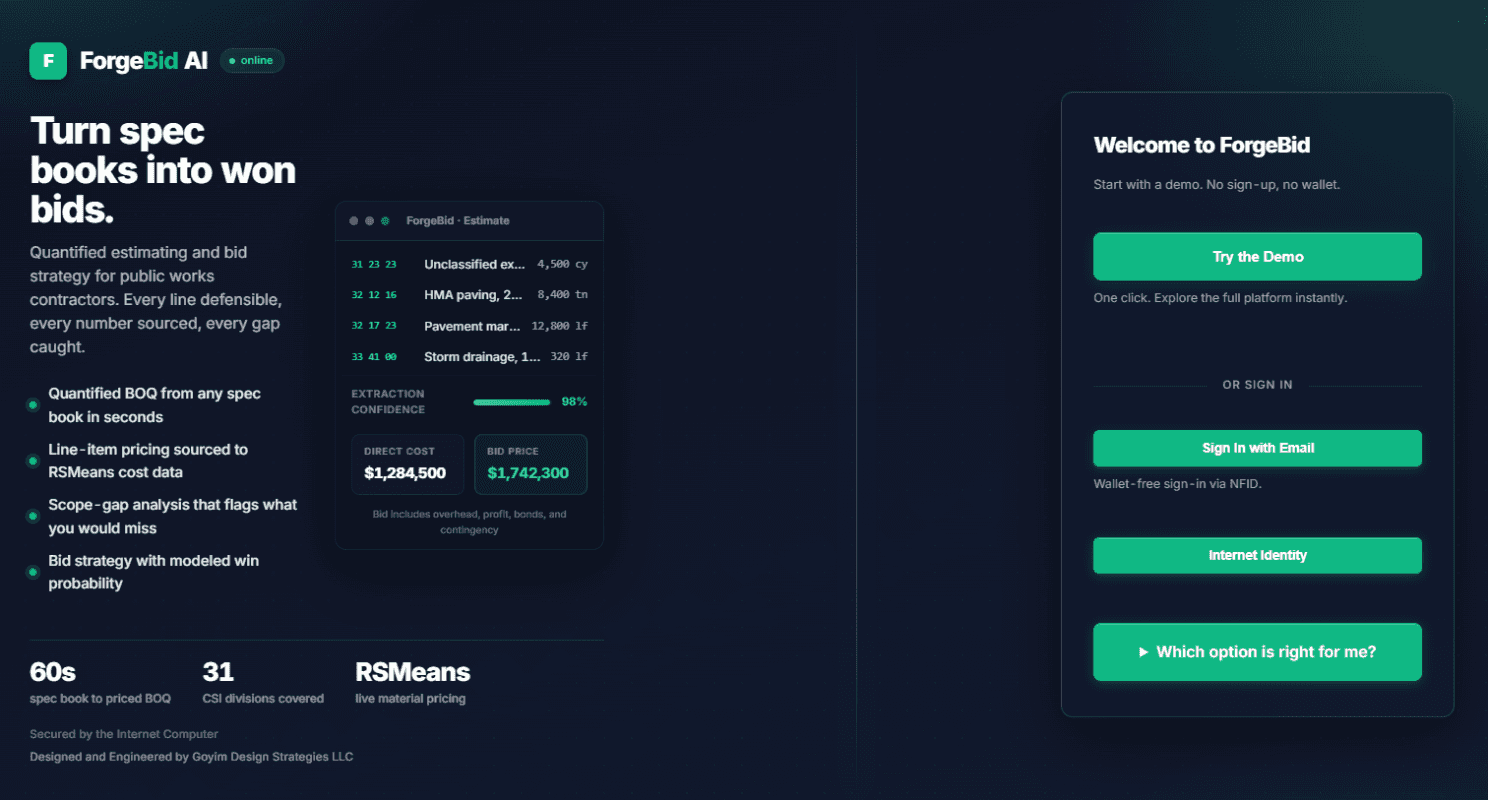
How we built ForgeBid AI, an estimating engine that catches the scope gaps costing contractors millions, and put it on the Internet Computer. A first-hand account from Goyim Design Strategies.
It starts with a number that doesn't leave you.
Nine out of ten construction projects go over budget. Only 31% come within 10% of what they said they'd cost. The mean cost overrun across the industry is 28%. And the reason isn't material prices, isn't labor, isn't inflation: it's that something was missing from the plans.
Scope gaps. The earthwork the architect didn't dimension. The traffic signal loop detector that milling will sever. The erosion control the NPDES permit requires but the drawings don't show. The firestopping at rated penetrations that the spec mentions on page 1,200 but the estimator missed at 11 PM the night before the bid was due.
By the time the contractor finds that gap, it's too late. They've signed the contract. The change order either doesn't come or comes at half the cost. That money is gone.
And here's the part that should make you uncomfortable: the tools contractors use to catch this have not meaningfully changed in three decades. Spreadsheets. Highlighters. RSMeans cost books. A junior estimator making $65,000, reading a 1,400-page spec book in 48 hours, hoping they don't miss anything. A senior estimator reviewing their work at midnight, running on coffee and instinct, responsible for a $4 million bid they have to defend if they win.
Twelve days ago, that reality became the reason we built ForgeBid AI.
This is the story of what we made, and why a design strategy firm out of California ended up deploying a real estimating intelligence platform onto the Internet Computer blockchain.
1. The Problem We Couldn't Stop Seeing
Public works contracting is a $400 billion industry in the United States alone. Every year, thousands of agencies (cities, counties, state DOTs, school districts, water authorities) publish bid packages for infrastructure projects. Every package is a PDF spec book: 200 to 2,000 pages of technical specifications, drawings, wage decisions, addenda, and bond requirements.
A contractor who wants to bid has to read that entire document, identify every piece of work they're responsible for, quantify it, price it, apply overhead and profit, check it for compliance, and submit it before a deadline that doesn't move.
The industry's own data tells us how that goes: 88% of projects face both cost overruns and delays, and the single most common cause isn't pricing: it's incomplete plans. As one analysis put it bluntly: "Most construction cost overruns are NOT because of price increases. They happen because something was missing."
We watched contractors lose money they didn't have to lose, not because they were bad at their jobs, but because the tools gave them no margin for error. And we kept asking the same question: why is there no software that reads the spec book, builds the bill of quantities, prices every line with real cost data, and tells you what you missed?
The answer, when we dug into it, was that building it required three things nobody had put together: real construction cost intelligence (not an AI hallucinating numbers), real industry estimating logic (variance propagation, scope-gap checklists, Davis-Bacon wage decisions), and a trust layer that made the data defensible.
So we built all three.
2. What We Built
ForgeBid AI is a platform that takes a contractor from spec book to submitted bid, with real intelligence at every step.
The core flow: You upload your bid documents (PDF spec books, drawings, bond letters, wage decisions). The platform extracts a bill of quantities, every line item, every CSI code, every unit of measure, using vision-capable AI that actually reads the documents. Not a guess. A real takeoff.
The pricing engine: Every line item gets priced with real data. We embedded RSMeans-published reference unit costs (labor, material, equipment) across 54 items spanning 13 CSI divisions. We layered in Davis-Bacon prevailing wage decisions with real rate and fringe references. We built a geographic pricing index using ENR Construction Cost Index data for 32 cities and 47 states, with county-level adjustments for 30 major construction counties. When a contractor in King County, Washington prices an HMA paving line, the number reflects what asphalt actually costs in Seattle, not a national average.
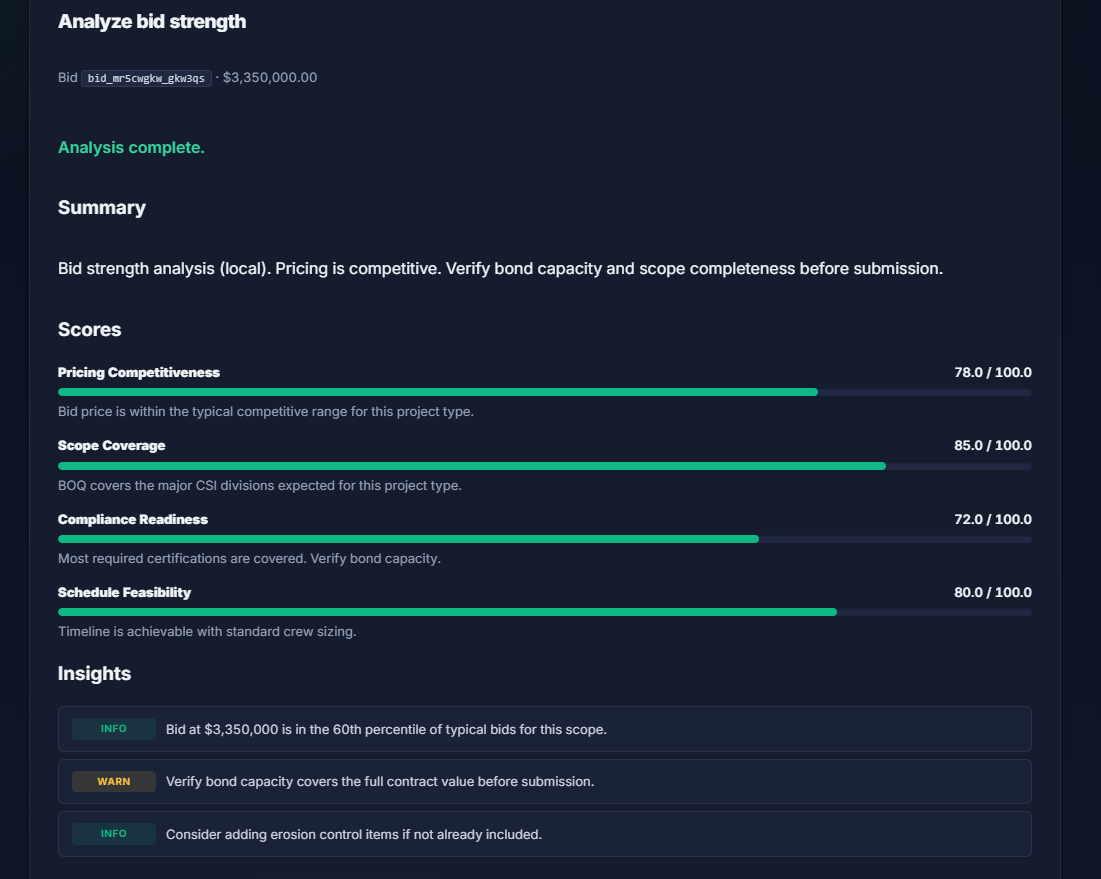
The confidence intervals: This is the part no competitor has. Every line item gets a real low-expected-high range, computed from the spread of cost sources and the extraction confidence. High-confidence items (verified RSMeans data) get tight bands, +/-8%. Low-confidence items (a guess, an unknown CSI code) get wide bands, +/-40%, that tell the estimator "you need to verify this manually." The bid total rolls up using statistical variance propagation: the sum of independent uncertainties, the square root of summed variances. It produces a Risk Band on the bid total that shows you where your exposure actually lives.
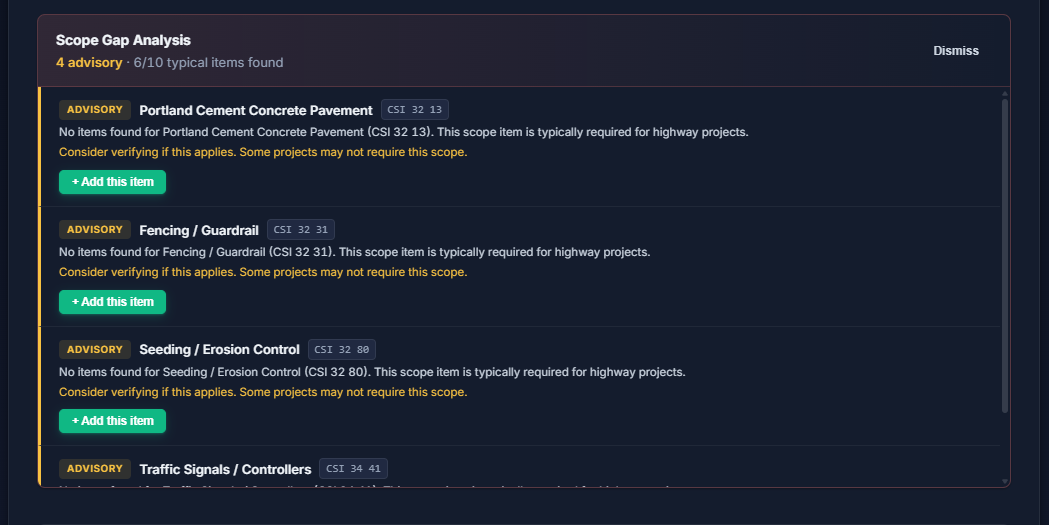
The scope-gap analysis: This is the feature that catches the gap. After extraction, the platform compares your bill of quantities against a checklist of scope items that the project type requires (highway, building, bridge, utility). If you're bidding a road project and there's no erosion control line item, it flags it as critical. If there's no pavement marking, it flags it. If the overlay raises the grade and there's no drainage inlet adjustment, it flags it. One click adds the missing item. Every gap caught here is money saved, money that otherwise becomes the 28% overrun.
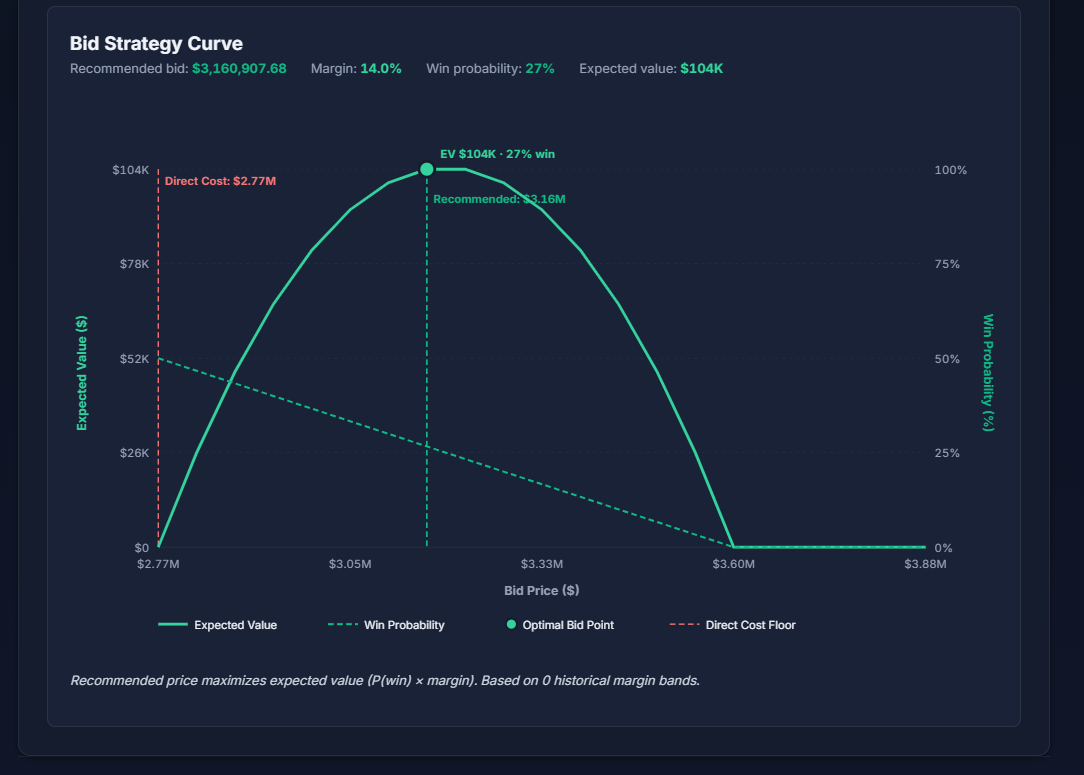
The bid strategy curve: Once the estimate is priced, the platform computes a game-theoretic optimization curve. For every candidate bid price, it calculates the expected value (win probability x margin) and identifies the price that maximizes it. The curve uses the contractor's real historical win-rate data when available, falling back to an industry-default model for new users. This is the kind of analysis that consultancies charge five figures to produce as a spreadsheet. ForgeBid renders it in 5 seconds.
The data moat: Every finalized estimate contributes anonymized cost data to an aggregate industry benchmark pool. Every awarded bid records its win/loss outcome. Over time, the platform gets smarter, the win-rate model becomes personalized, the cost benchmarks become sharper, the pricing becomes more accurate. This is the network effect that makes the platform more valuable with every user.
3. The Numbers Behind the Build
Twelve days. Roughly 3,200 lines of code, 2,500 in Motoko (the Internet Computer's native language) across 39 backend modules, plus the React frontend and the off-chain PDF extraction service.
Two full audit passes. The first surfaced 17 bugs: Candid binding mismatches that would have crashed the app on real data, non-exhaustive switch statements that would have trapped the canister on valid input, frontend crashes from rendering raw blockchain variant objects as React children. The second surfaced 5 more, including a compile error in the research report module and a strategy chart that broke the entire page on mobile. All fixed.
The confidence interval math alone went through three iterations. The first version produced honest but artificially narrow bands. When pricing used a single source (the common case), the spread collapsed to zero and every line showed perfect certainty. That's dishonest. We rebuilt it to derive realistic ranges from the confidence tier itself, mirroring how RSMeans publishes its own cost ranges. Now a verified item shows +/-8% and a guess shows +/-40%, and the estimator trusts the number because it admits its own uncertainty.
The deployment itself was a journey. The backend lives on the Internet Computer blockchain, a Motoko canister running on mainnet, decoupled from any single server, with the audit trail and cost data stored on-chain. The frontend is hosted separately for speed and a clean URL. The architecture is genuinely decentralized where it matters (the canister, the data, the logic) and practical where it needs to be (the PDF extraction service stays off-chain because it calls OpenAI. You can't run an API key on a blockchain).
4. Why This Matters for the Industry
The construction industry has a productivity problem that economists have been measuring for fifty years. While the rest of the economy has roughly doubled its productivity since 1970, construction has stayed flat. One of the biggest reasons: the bidding process is still manual, still error-prone, and still punishes the contractor who's honest about what they don't know.
ForgeBid AI doesn't solve that by replacing the estimator. It solves it by giving the estimator a tool that's faster than a spreadsheet, more honest than a gut call, and more complete than a human reading a 1,400-page spec book at midnight. The scope-gap analysis alone, a feature that takes five seconds to run and flags the missing work, represents the kind of value that pays for itself on the first bid.
And the confidence intervals change the conversation. When a contractor walks into a principal's office and says "the bid is $3.2 million, but the Risk Band is $3.0 to $3.4 million because three line items are low-confidence," that's a fundamentally different conversation than "the bid is $3.2 million." It's a conversation about where the risk is, not whether the number is right. That's the conversation every contractor should be having, and almost none of them have the tools to have it.
5. Goyim Design Strategies: Building the Tools the Industry Needs
We're not a construction company. We're a design strategy firm, but when we looked at the public works industry, we didn't see a design problem. We saw a tooling problem. The contractors losing money to scope gaps weren't failing because they lacked strategy. They were failing because the strategy tools didn't exist.
So we built them.
Goyim Design Strategies exists at the intersection of technology, design, and industry pain. We identify the workflows that are broken, the ones where the cost of the status quo is measured in six-figure losses, and we build the platform that fixes them. ForgeBid AI is our flagship: a real product, on the blockchain, with real cost data, serving a real industry that has been waiting for this for thirty years.
This isn't a demo. It's not a prototype. It's a deployed platform, live, accessible, and ready for contractors who want to stop leaving money on the table.
6. The Road Ahead
ForgeBid AI is live. The backend runs on the Internet Computer mainnet. The estimating engine prices real line items with real data. The scope-gap analysis catches real missing work. The strategy curve computes real expected value.
What's next: opportunity feeds that pull public bid listings, historical competitor intelligence that sharpens the win-rate model, and integration with procurement portals so the bid submission is as automated as the estimate.
But the core is done. The thing that catches the gap, it's built, it's deployed, and it works.
7. Is This Something You'd Want for Your Business?
If you bid public works projects (roads, schools, utilities, bridges, commercial buildings), ForgeBid AI is the platform that turns a 48-hour panic into a 2-hour workflow. It catches the scope gaps. It prices the work honestly. It shows you where your risk is. And it gives you a bid strategy backed by real math, not a gut feeling.
If you're a contractor who's ever lost money on a bid because something was missing, or a firm that wants to offer smarter estimating to your clients, this is built for you.
Book a free strategy call with us. We'll walk you through the platform, show you how the scope-gap analysis works on a real bid, and talk about what it would look like to bring this to your projects.
goyimdesignstrategies.com/contact
I just put the whole thing live. You can actually use it right now, not just look at screenshots. Upload a bid, watch it extract the quantities, price every line, and flag the scope gaps you'd miss.
Try it yourself: https://goyimdesignstrategies-forgebid-ai.netlify.app
The bids you don't lose are the ones that grow your business. Let's make sure you don't lose them.
Frequently Asked Questions
Q:What is ForgeBid AI?
ForgeBid AI is a platform that takes a contractor from spec book to submitted bid, with real intelligence at every step. It extracts a bill of quantities from bid documents, prices every line item with real RSMeans cost data and Davis-Bacon wage decisions, computes confidence intervals, runs a scope-gap analysis that flags missing work, and produces a game-theoretic bid strategy curve. The backend runs on the Internet Computer blockchain.
Q:How does the scope-gap analysis catch missing work?
After extraction, the platform compares the bill of quantities against a checklist of scope items that the project type requires, such as highway, building, bridge, or utility. If a road project has no erosion control line item, it flags it as critical. One click adds the missing item. Every gap caught here is money saved that otherwise becomes the 28% industry-wide cost overrun.
Related Articles
Share this article

Founder · Lead Developer
Marcus Belmares
Goyim Design Strategies
Marcus is a self-taught developer and the founder of Goyim Design Strategies, one of fewer than 50 developers in the United States, and the only one in San Diego, combining ICP decentralized hosting, multi-agent AI systems, and full-stack agency services. He works directly with every client, delivering premium websites and custom applications in 1-4 weeks with full code ownership.
READY TO BUILD?
Build the Platform Your Industry Needs
ForgeBid AI is live, on the blockchain, with real cost data and real scope-gap analysis. See what we build, or explore the packages that get you there.