Why Construction Procurement Is Broken and What It Will Take to Fix It
By Marcus Belmares
Founder & Lead Developer at Goyim Design Strategies, San Diego, California
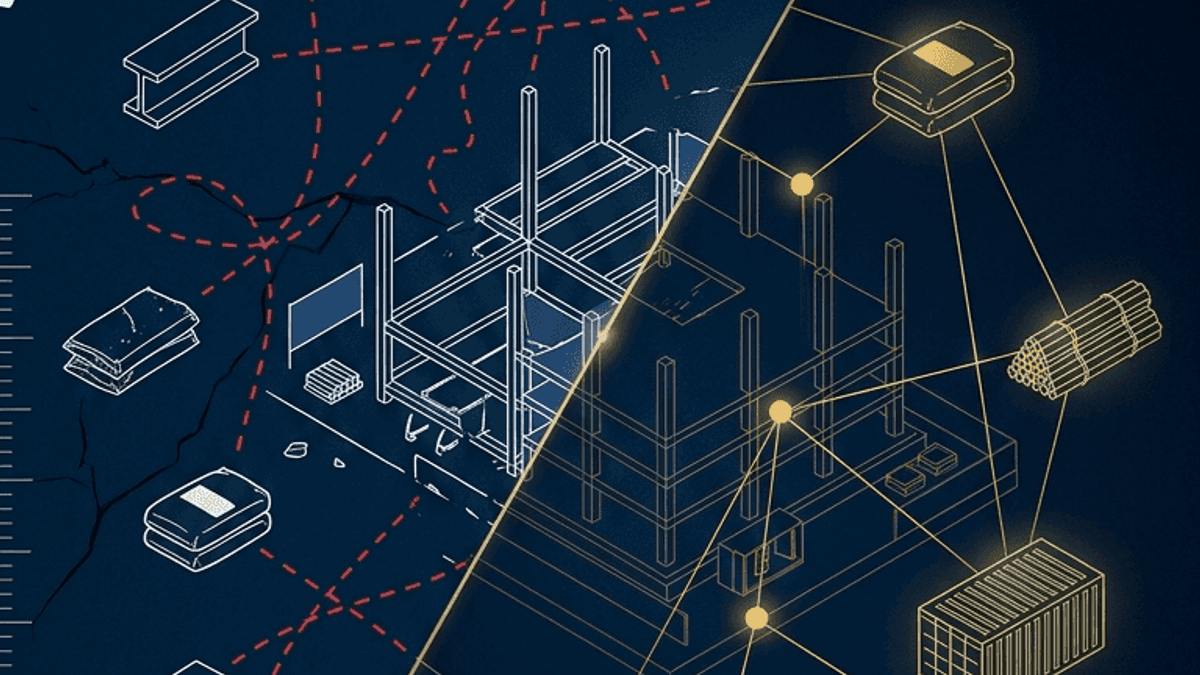
The Broken Reality of Construction Procurement
For decades, the construction industry has operated under a procurement system that is slow, opaque, and deeply inefficient. Contractors lose significant amounts of money every year not because of poor workmanship or bad project management, but because the systems they rely on to buy materials and manage supply chains were never designed for the speed and complexity of modern construction.
Common Industry Problems
The problems are well known inside the industry, even if they are rarely discussed openly with clients. Material prices can swing dramatically between the time a bid is submitted and the time materials are actually purchased. Supply chains can be disrupted with little warning, leaving crews idle and schedules in chaos. Administrative work such as RFIs, submittals, change orders, and compliance documents is still largely manual, creating delays and errors that can stall entire projects.
These issues are not caused by a lack of effort from contractors or suppliers. They are the result of a fragmented system that was never built to handle the volume, speed, and coordination required today. Each part of the supply chain operates in isolation, with limited visibility into what is happening elsewhere. When problems arise, the cost and risk are almost always pushed down to the contractor.
How Goyim Design Strategies Found the Solution
This is the environment in which BuildForge was created. As a San Diego-based agency that works closely with contractors on bidding, compliance, and digital tools, Goyim Design Strategies saw these problems firsthand across dozens of projects. Rather than trying to improve individual parts of the existing system, the platform was designed to replace the entire procurement process with a coordinated, intelligent operating system. The goal is to give contractors real leverage, real visibility, and real control over their supply chains for the first time.
How Coordinated AI Agents Work
At the center of this approach is the use of coordinated AI agents that can perform specialized tasks simultaneously. Instead of waiting for one person or team to complete a step before moving to the next, multiple specialized functions operate in parallel. One set of agents can analyze blueprints and generate material takeoffs while another set negotiates with suppliers across different regions. At the same time, predictive systems can flag potential shortages or price changes before they become expensive problems.
Economic Impact
This level of coordination changes the economics of procurement. When agents can monitor markets continuously and negotiate across many suppliers at once, contractors gain access to pricing and availability that would be impossible to achieve through traditional methods. Small and mid-sized contractors, who have historically been at a disadvantage compared to larger firms, can now participate in buying power that was previously reserved for major players.
Sovereign Infrastructure
Another important element is the infrastructure on which BuildForge is built. Rather than relying on traditional centralized servers, the platform operates on sovereign infrastructure. This means that every transaction, every material record, and every audit trail lives in a system the contractor actually controls. There is no risk of data lock-in or sudden changes in platform rules that could disrupt operations.
Transparency and Accountability
Transparency is also a core part of the design. Supplier performance is tracked and made visible in a way that removes the information advantage suppliers have traditionally held. Contractors can see which suppliers deliver on time, which ones have quality issues, and which ones create unnecessary administrative burden. This data makes it possible to make better decisions and hold suppliers accountable in ways that were not practical before.
The same transparency applies to cost. BuildForge is designed to expose exactly where money is being lost across the supply chain. Instead of discovering problems after a project is complete, contractors can see in real time where costs are drifting and take action before the impact becomes significant.
Why BuildForge Is Different
What makes this approach different from previous attempts to modernize construction procurement is the combination of intelligence and sovereignty. Many existing tools focus on digitizing old processes or adding limited automation. BuildForge starts from the assumption that the current system itself is the problem and must be replaced with something fundamentally more capable.
Industry-Wide Impact
This matters because construction procurement does not exist in isolation. When contractors lose money on materials, when projects are delayed by supply chain issues, and when administrative work consumes excessive time, those costs eventually reach owners, developers, and the public. Improving procurement is not just a contractor problem. It is an industry-wide problem that affects timelines, budgets, and the quality of what gets built.
The Future Direction
The shift toward intelligent, sovereign procurement systems is still in its early stages. However, the direction is clear. Contractors who continue to rely on fragmented, manual processes will find it increasingly difficult to compete on cost, speed, and reliability. Those who adopt systems that coordinate specialized work at scale will be able to deliver more predictable results with less waste and less risk.
BuildForge represents one of the most ambitious attempts to address these problems at their root. By combining coordinated AI agents, sovereign infrastructure, and collective buying power, it aims to give contractors the tools they have needed for a long time but have never had access to. Whether this approach becomes the new standard remains to be seen, but the problems it targets are real, expensive, and long overdue for a serious solution.
Try BuildForge Yourself
You can try the fully functional live demo for yourself right now and see how it works in real bidding scenarios. https://buildforge-b2b-demo-bht.caffeine.xyz/
Frequently Asked Questions
Q:Why is construction procurement so inefficient today?
Construction procurement relies on fragmented systems that were never designed for the speed and complexity of modern construction. Material prices swing between bid and purchase, supply chains can be disrupted with little warning, and administrative work like RFIs, submittals, and change orders is still largely manual. Each part of the supply chain operates in isolation with limited visibility into what is happening elsewhere.
Q:How do coordinated AI agents change construction procurement?
Coordinated AI agents perform specialized tasks simultaneously instead of waiting for one team to finish a step before moving to the next. One set of agents can analyze blueprints and generate material takeoffs while another negotiates with suppliers across regions, and predictive systems flag potential shortages or price changes before they become expensive problems.
Q:What does sovereign infrastructure mean for contractors using BuildForge?
Sovereign infrastructure means every transaction, material record, and audit trail lives in a system the contractor actually controls. There is no risk of data lock-in or sudden changes in platform rules that could disrupt operations, because the contractor owns the infrastructure rather than renting it from a centralized provider.
Q:How does BuildForge help small and mid-sized contractors compete?
When agents can monitor markets continuously and negotiate across many suppliers at once, contractors gain access to pricing and availability that would be impossible to achieve through traditional methods. Small and mid-sized contractors can now participate in buying power that was previously reserved for major players.
Related Articles
Share this article

Marcus Belmares
Founder & Lead Developer, Goyim Design Strategies
Marcus is a self-taught developer and the founder of Goyim Design Strategies, one of fewer than 50 developers in the United States, and the only one in San Diego, combining ICP decentralized hosting, multi-agent AI systems, and full-stack agency services. He works directly with every client, delivering premium websites and custom applications in 1-4 weeks with full code ownership.
READY TO BUILD?
Ready to Fix Your Construction Procurement?
Let us build a coordinated procurement platform engineered for your contracting business. Full code ownership, sovereign infrastructure, and intelligent automation built for San Diego contractors.