Why We Build on the Internet Computer, Not AWS(And Why It Changes Everything for Your Business)
By Marcus Belmares
Founder & Lead Developer at Goyim Design Strategies, San Diego, California

Right now, as you read this, nearly every website on the internet is renting space on someone else's server. Amazon's servers. Google's servers. Microsoft's servers. When a traditional web agency "builds" your website, they're almost always deploying it onto Amazon Web Services, and that means Amazon has a quiet hand in your business whether you know it or not.
One policy change. One billing dispute. One account suspension. And your business disappears from the internet overnight. This isn't hypothetical, it has happened to thousands of businesses, and it will keep happening. The AWS us-east-1 outage in December 2021 took down Netflix, Disney+, Ring, Slack, and thousands of unrelated small businesses simultaneously. They all had one thing in common: they were all tenants in Amazon's building.
Goyim Design Strategies made a deliberate choice to build on something fundamentally different: the Internet Computer Protocol , not just another cloud provider, but a completely different paradigm where your website lives on a decentralized global network owned by no corporation on earth. Here's what that means, why it matters, and why it changes everything for your business.
In This Article
- 1What Is the Internet Computer Protocol (ICP)?
- 2How the Internet Computer Actually Works
- 3ICP vs AWS: The Head-to-Head Comparison
- 4What This Means for Your Business
- 5The Network Nervous System: Who Really Controls ICP?
- 6Chain-Key Cryptography: The Technical Breakthrough
- 7Decentralized Hosting vs Traditional Hosting: Real-World Examples
- 8Why Most Agencies Don't Build on ICP
- 9The Future of the Internet Computer
1. What Is the Internet Computer Protocol (ICP)?
The Internet Computer Protocol was created by the DFINITY Foundation, a Swiss non-profit research organization, and launched publicly in May 2021. It is often described as a "world computer", a blockchain-based, fully decentralized cloud platform that can host websites, web applications, and data directly on-chain.
This is not simply another cryptocurrency or a speculative token. The ICP is a complete computing platform. Applications built on it, called canisters, run directly as web applications. Users visit them in a browser like any normal website, with no indication that the underlying infrastructure is fundamentally different from anything they've ever used before.
What makes it revolutionary is what's absent: there is no AWS, no Google Cloud Platform, no Microsoft Azure, no DNS registrar, no CDN, and no separate database required. The Internet Computer is a complete, self-contained computing environment. Your site, your app, and your data all live on the same decentralized network.
40+
Countries with active ICP nodes
2021
Year ICP launched publicly (Genesis)
NNS
Governed by the Network Nervous System DAO
0
Corporate owners: no Amazon, Google, or Microsoft
The ICP is governed by the Network Nervous System (NNS), a decentralized autonomous organization (DAO) that upgrades and manages the network. Nodes run in independent data centers across more than 40 countries. No single corporation controls them. No single corporation can shut them down.
Today, the Internet Computer hosts hundreds of decentralized applications, DeFi platforms, NFT platforms, social networks, enterprise applications, and, websites like yours.
2. How the Internet Computer Actually Works
Understanding the Internet Computer doesn't require a computer science degree, but knowing the basics helps you understand why it's genuinely different from anything that came before.
Subnet Architecture: The ICP is organized into subnets, groups of independent nodes that work together. Each subnet runs consensus independently, meaning even if some nodes fail or are compromised, the subnet continues running. Think of it as dozens of mini-networks, each self-healing, all interconnected.
Canisters: Smart Contracts as Full Applications: On ICP, smart contracts are called canisters. But unlike the smart contracts you may have heard of on Ethereum (which only hold data and execute simple logic), ICP canisters can hold persistent state, serve complete web content, process user requests, and execute full application logic. A canister IS the backend and frontend simultaneously, a self-contained application that runs on the network forever.
WebAssembly Execution: All canister code compiles to WebAssembly, a sandboxed, deterministic execution environment. This means code runs identically on every node. There's no "works on my machine" problem, no environment drift, no configuration mismatch.
Orthogonal Persistence: Canisters automatically persist state without a separate database. The runtime handles storage transparently, and your application data is simply "there," preserved across upgrades, replicated across nodes, cryptographically secured.
Reverse Gas Model: Here's something AWS users never experience on blockchain platforms: users don't pay transaction fees. On ICP, the canister itself holds "cycles", computational fuel, so end users get a completely normal web experience. They click a button and the application responds. No wallet required. No gas fees. No friction.
HTTP Outcalls & Inter-Canister Communication: Canisters can call external APIs directly without trusting a centralized oracle. They can also communicate with each other across subnets, enabling complex multi-service architectures that remain fully decentralized.
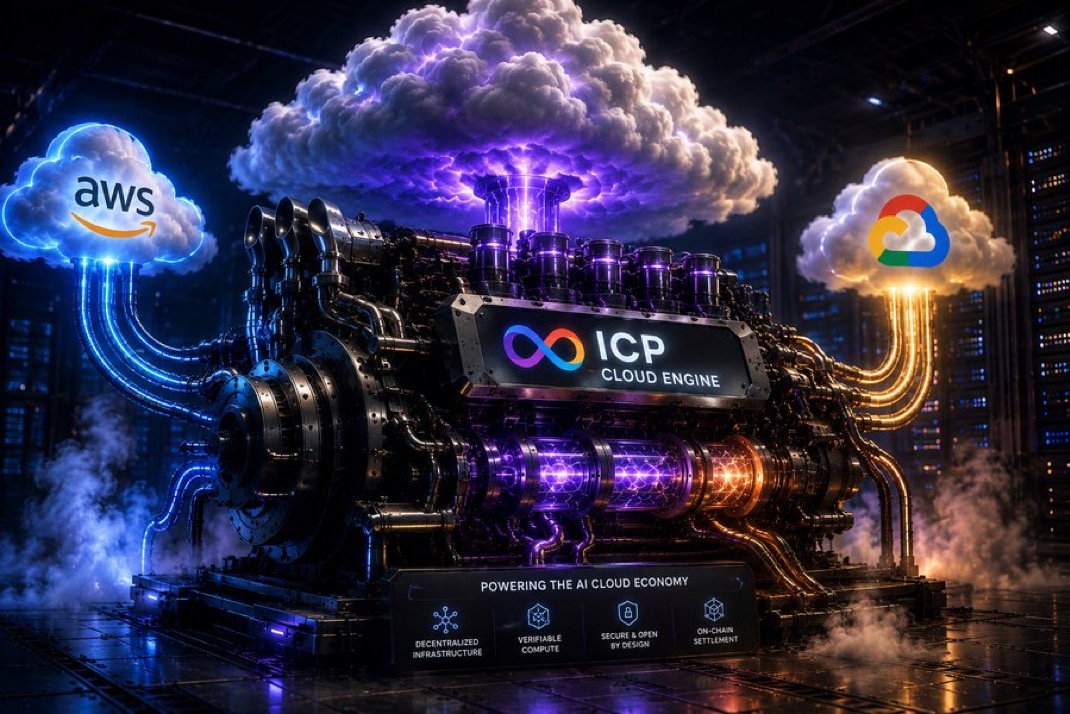
Building something real: the Internet Computer's decentralized infrastructure, piece by piece.
3. ICP vs AWS: The Head-to-Head Comparison
Let's be direct. The differences between hosting on the Internet Computer and hosting on Amazon Web Services are not cosmetic. They touch every dimension of your business's digital infrastructure: ownership, security, privacy, pricing, uptime, and sovereignty. Here's the full breakdown.
Ownership
AWS
You rent. Amazon owns the infrastructure. They can suspend, modify pricing, or take it down.
ICP
Your code runs in canisters on a decentralized network. No single company owns any of it.
Censorship Resistance
AWS
Amazon has taken down services (Parler, WikiLeaks). You're subject to their Terms of Service, always.
ICP
No entity can take down your canister. It runs as long as the network runs, governed by open voting, not corporate policy.
Security
AWS
Centralized servers = single points of failure. AWS outages (2020, 2021, 2023) cascaded across thousands of unrelated businesses.
ICP
Distributed across 40+ countries. Chain-key cryptography makes every state transition tamper-proof and cryptographically verified.
Privacy
AWS
Amazon stores your data, can access your data, and is subject to US government subpoenas under the CLOUD Act.
ICP
Code and data live in canisters. Execution is verifiable and transparent. No corporation holds your clients' data.
Vendor Lock-In
AWS
Migrating off AWS is a massive undertaking. Proprietary APIs (DynamoDB, Lambda, S3, CloudFront) trap you in their ecosystem.
ICP
Open standard. Your canister runs on a public protocol. The code you write is yours, portable and free from proprietary lock-in.
Pricing Model
AWS
Pay per request, per GB stored, per data transfer. Complex pricing scales unpredictably. Surprise bills are common.
ICP
Simple cycles model. Cycle costs are tied to computational work, not to AWS's quarterly pricing decisions. No billing shocks.
Uptime & Reliability
AWS
99.99% SLA on paper, but real outages affect millions of businesses simultaneously when us-east-1 goes down.
ICP
Subnet-level redundancy. No single datacenter failure affects the whole network. Subnets run independent consensus.
Performance
AWS
Fast, but dependent on CDN config, region selection, and cache tuning. Requires DevOps expertise.
ICP
Sub-second query responses. Certified variables allow clients to verify responses are authentic without trusting any single node.
Compliance & Sovereignty
AWS
Subject to US law, CLOUD Act, and whatever jurisdiction AWS operates in. EU GDPR and healthcare HIPAA compliance is complex.
ICP
Distributed globally. Node selection can be tuned for geographic or regulatory requirements. No single government controls it.
4. What This Means for Your Business
Everything above is technical context. Here's what it means for you, specifically, as a business owner:
Your website cannot be taken offline by a corporate decision.
No account suspension, no policy change, no pricing dispute can make your site disappear. The network runs as long as the protocol runs, and the protocol is governed by open voting, not a boardroom.
Your client data is not stored on Amazon's servers.
When a client submits a form on your site, their data is not processed by AWS infrastructure, not subject to the CLOUD Act, and not co-mingled with millions of other corporate accounts on shared server infrastructure.
No monthly hosting fees that climb as you grow.
Traditional AWS costs scale with traffic, storage, and data transfer. The ICP cycle model is predictable and tied to actual compute, not to Amazon's revenue targets.
True digital sovereignty, from code to infrastructure.
With GDS, you receive 100% full code ownership and your site runs on decentralized infrastructure. You own the code. You own the domain. The ground your site stands on belongs to no single entity. That is what self-custody truly means.
No dependency on any single corporation for your online presence.
Amazon, Google, and Microsoft each have the technical and legal ability to impact your website's availability. Building on ICP removes that dependency entirely. Your business's digital presence is yours, period.
This is what "self-custody" means in practice, not just owning your code, but owning where it lives. Goyim Design Strategies delivers both: the full code and design files are yours, and the infrastructure runs on ICP. No single point of control. No single point of failure. No landlord.
5. The Network Nervous System: Who Really Controls ICP?
Here's a question most people never think to ask about their hosting provider: who makes the rules? With AWS, the answer is simple, Amazon does. Jeff Bezos built it. Amazon runs it. Amazon sets the terms. Amazon decides what you're allowed to host and what they'll take down.
With the Internet Computer, that question has a fundamentally different answer. No one. And everyone.
The ICP is governed by the Network Nervous System (NNS) , a decentralized autonomous organization where ICP token holders propose and vote on changes. Protocol upgrades, node onboarding, economic parameters, and governance decisions all require community consensus. Node providers must be approved by NNS governance vote. No single entity can push a change through unilaterally.
Think of it this way: what would happen if the internet's DNS root was controlled by a DAO instead of ICANN, a private nonprofit whose board can be influenced by governments and corporations? That's the direction ICP pushes toward. A commons-governed protocol, not a privately owned infrastructure monopoly.
There is no CEO of the Internet Computer. There is no board of directors. There is no single company that can decide your site violates their new community standards. The rules are encoded in the protocol, and changing the protocol requires a community vote. That is an entirely different kind of infrastructure guarantee than any commercial cloud provider can offer.
6. Chain-Key Cryptography: The Technical Breakthrough
If one concept makes the Internet Computer genuinely different at the cryptographic level, it's chain-key cryptography. This is not marketing language. It's the technical breakthrough that makes decentralized web hosting at this scale possible.
In simple terms: chain-key means the entire ICP network can be verified with a single 48-byte public key. This is orders of magnitude more efficient than traditional blockchains. To verify a Bitcoin transaction, you theoretically need to download the entire chain, hundreds of gigabytes of history. With ICP, the entire network's state can be verified cryptographically against a single, compact key. Fast. Efficient. Tamper-proof.
Threshold BLS Signatures: No individual node can forge a transaction or sign a response. A threshold, a quorum of nodes, must agree and cryptographically sign every response. This means that even if an adversary compromises a minority of nodes on a subnet, they cannot corrupt the output. The signature either has enough honest nodes behind it, or it doesn't. There's no middle ground.
What this means for your business: When a user visits your website on ICP, the response they receive is cryptographically signed by the network. They can verify, mathematically, that the page they're seeing is the real code running on the real network, not a hacked or man-in-the-middle modified version. That level of cryptographic authenticity is simply not possible on AWS, where you're trusting Amazon's internal security team to ensure the code they're serving is actually yours.
Technical Summary
Chain-key cryptography gives ICP three properties no centralized cloud can match: (1) verifiable code integrity , users can prove they're interacting with the real application; (2) threshold signing, no single node can corrupt output; and (3) a single 48-byte key that represents the entire network's trust, making the system both scalable and auditable.
7. Decentralized Hosting vs Traditional Hosting: Real-World Examples
This isn't theoretical risk management. It's documented history. Here are real AWS and centralized infrastructure outages that cost businesses revenue, reputation, and customer trust:
Took down Adobe Spark, Disney+, Roku, and thousands of business websites simultaneously. Businesses had no recourse, they waited for Amazon to fix it.
Slack, Epic Games, Kindle, Ring, and thousands of small businesses went dark. A single data center region failure cascaded across the internet.
Massive sections of the internet went offline simultaneously, including Discord, Shopify, Canva, and many others. Another example of centralized infrastructure creating correlated risk.
Widespread disruptions affecting services globally, including financial services, healthcare platforms, and media companies, all at once.
Every single one of those businesses had to tell their customers: "Sorry, we can't help you right now. Amazon is down." On ICP, subnet-level failures don't cascade. One subnet can experience issues while the rest of the network continues running normally. There is no single us-east-1. There is no shared single point of failure. The architecture is designed from the ground up to prevent the correlated risk that defines centralized cloud infrastructure.
8. Why Most Agencies Don't Build on ICP
If the Internet Computer is genuinely superior in these ways, why isn't every agency building on it? The answer is straightforward:
Most agencies don't know it exists.
The ICP is not discussed in mainstream web development circles. Most developers learn React, Node.js, AWS, and call it done. The ICP requires deliberate exposure to a different part of the industry.
AWS is the default, not the decision.
Most web developers are AWS-trained. AWS certifications are a massive industry. Everyone defaults to AWS not because it's the best choice for their clients, but because it's the path of least resistance for their workflow.
Learning the ICP stack requires real investment.
Building on ICP requires learning Motoko (ICP's native language) or Rust with the IC SDK, understanding canister architecture, and rethinking how persistence, state, and identity work. Most agencies won't make that investment.
"Nobody got fired for buying IBM."
Most clients don't ask about hosting infrastructure. Agencies know this. Using AWS requires zero explanation. It's familiar, it sounds safe, and no one questions it. That complacency is not in your interest as a client.
GDS made a deliberate choice: learn the hardest stack because it delivers the most value for clients. We are one of very few agencies in San Diego, or the country, building production websites on ICP. This isn't a gimmick. It isn't a buzzword. It's a technical decision with real consequences for your security, your ownership, and your sovereignty.
9. The Future of the Internet Computer
The Internet Computer is not a finished product, it's an active protocol being developed at the frontier of what's technically possible. The roadmap includes capabilities that will further widen the gap between ICP and traditional cloud infrastructure:
vetKeys
Allows encrypted data to be processed without the decryption key ever leaving the network. A breakthrough for privacy-preserving applications, healthcare, finance, legal, and any industry where data confidentiality is non-negotiable.
Native Bitcoin Integration
Canisters can hold and send real Bitcoin natively, without a bridge, without a custodian, without trusting a third party. Your application handles Bitcoin as a first-class primitive.
Ethereum Integration
Direct integration with the Ethereum network, enabling DeFi, token standards, and Ethereum-native applications to run entirely on ICP's decentralized infrastructure.
On-Chain AI Models
AI inference directly on the ICP network, without sending data to external third-party APIs. Privacy-preserving intelligence that runs inside your canister.
The vision is an internet that no single entity controls: not Amazon, not Google, not Cloudflare, not any government. An internet where applications run as public goods on shared, open infrastructure. Where cryptographic proof replaces corporate trust. Where your website is as permanent and uncensorable as the protocol itself.
Building on ICP today puts your business at the leading edge of where the internet is going. Not behind it.
10. The Real Cost Advantage: What This Means for Your Wallet
Every benefit we've covered so far, decentralization, chain-key cryptography, censorship resistance, true ownership , is a technical and strategic advantage. But there is a fourth dimension that most agencies never mention honestly: the cost.
Traditional AWS Hosting
$50–$200+/month
VPS instances, load balancers, CDN delivery, automated backups, uptime monitoring tools, and data transfer fees, all billed separately, all scaling unpredictably.
Internet Computer Hosting
Fractionsof a dollar/month
A standard marketing website on ICP consumes a trivially small amount of compute cycles. For most business sites, the raw hosting cost is negligible, often less than a cup of coffee per year.
Annual Savings
$600–$2,400+/year eliminated
Pure server cost savings that can be reinvested directly into SEO campaigns, content creation, paid advertising, or any growth channel that generates real returns.
✦ THE BOTTOM LINE
Your site runs on infrastructure owned by no single company. There is no AWS bill. No GCP invoice. No corporate landlord charging you rent for your own website.
Here is the distinction that matters: when you work with Goyim Design Strategies and keep your site on the Internet Computer, any ongoing monthly fee you pay is entirely for management expertise , proactive monitoring, security patches, performance tuning, SEO maintenance, algorithm update responses, and direct developer support. You are not paying for server rental. You are not paying a hosting markup. You are paying for a skilled professional actively keeping your digital system sharp, fast, and ahead of competitors.
Compare that to the typical agency arrangement: a monthly fee that bundles a server markup, a platform license, and occasionally some SEO work, with no transparency about what you're actually paying for. On ICP, the hosting economics are transparent because they're essentially zero. If you ever choose to take your code elsewhere, you own it outright and can host it on any platform you choose. That's what true self-custody means.
WHERE YOUR SAVINGS GO INSTEAD
SEO & Content
Invest $600–$2,400/year in content that compounds in search rankings, pages that generate leads for years.
Paid Advertising
Put those server dollars directly into Google or Meta campaigns with a measurable, immediate return.
Business Growth
Every dollar not spent on infrastructure overhead is a dollar working toward customer acquisition and brand building.
We didn't choose the Internet Computer because it's easy. We chose it because it's right. Because our clients deserve to own not just their code, but the infrastructure their business runs on. That's not a technical footnote. It's the foundation of what true digital ownership means in 2026.
If true digital sovereignty, code you own, infrastructure no one controls, matters to you and your business, let's talk about what building on ICP looks like for you. Or explore our packages to see what a complete ICP-hosted digital system costs.
Share this article

Founder · Lead Developer
Marcus Belmares
Goyim Design Strategies
Marcus is a self-taught developer and the founder of Goyim Design Strategies, one of fewer than 50 developers in the United States, and the only one in San Diego, combining ICP decentralized hosting, multi-agent AI systems, and full-stack agency services. He works directly with every client, delivering premium websites and custom applications in 1-4 weeks with full code ownership.
Continue Reading
Technology
How Multi-Agent Intelligence is Revolutionizing Web Design in 2026
Discover how coordinated AI agent systems are delivering premium websites in weeks, not months.
Strategy
Full Code Ownership: What It Means for Your Business
Why owning 100% of your source code matters more than ever in 2026—and how template builders lock you in.
Frequently Asked Questions
What is ICP decentralized hosting?
ICP (Internet Computer Protocol) is a decentralized cloud platform that hosts websites and applications on a global network of independent data centers. Unlike traditional AWS or shared hosting that charges monthly server rental fees, ICP hosting costs are dramatically lower—often $0 for standard websites.
How much does ICP hosting cost compared to AWS?
Traditional AWS hosting costs $50–$200+ per month. ICP hosting for a standard business website costs fractions of a dollar per month—often less than a cup of coffee per year. The annual savings range from $600 to $2,400+.
Do I still own my code if I use ICP hosting?
Yes. Every project includes 100% full code ownership regardless of hosting choice. You receive all source code, design files, and assets upon delivery. If you ever choose to take your code elsewhere, you can host it on any platform you choose.
Is ICP hosting reliable for business websites?
Absolutely. ICP uses chain-key cryptography, independent node operators, and autonomous governance to provide enterprise-grade reliability without a single point of failure. Your site runs on infrastructure owned by no single company.
BUILT ON THE DECENTRALIZED CLOUD
Your Site. Your Code. No AWS. No Landlord.
Get a premium digital system built on the Internet Computer, decentralized, resilient, and owned entirely by you. No Amazon. No Google. No single point of failure. No corporate terms of service standing between you and your business's online presence.